

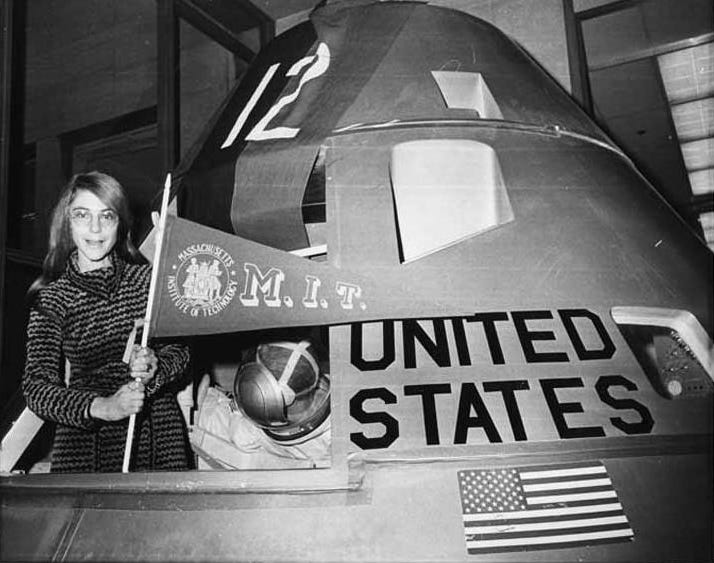
Margaret Hamilton with an MIT pennant, standing inside an Apollo 12 command module mock-up, 1969. Photo credit: MIT Museum
When the news of MIT computing legend Margaret Hamilton’s death broke yesterday, I did what I usually do when a highly visible spaceflight pioneer dies: I wrote a brief but comprehensive obituary for Space Hipsters, the Facebook group I founded nearly 16 years ago. As always, I did some research before I hit “post,” and was careful not to parrot things that have been misrepresented in AI slop memes and even Wikipedia articles.
I wanted to emphasize that Hamilton led the Software Engineering Division of the MIT Instrumentation Laboratory, and pointed out that she wasn’t the sole writer of all the code she stood by in the now-famous late 1960s photo of her standing by stacks and stacks of it. Hamilton herself discussed being part of a team in a 2009 MIT News interview, and enthused, “We took our work seriously, many of us beginning this journey while still in our 20s. Coming up with solutions and new ideas was an adventure. Dedication and commitment were a given. Mutual respect was across the board. Because software was a mystery, a black box, upper management gave us total freedom and trust. We had to find a way, and we did. Looking back, we were the luckiest people in the world; there was no choice but to be pioneers.” Notice she used the personal pronoun “we,” not “I.” Like many Apollo astronauts of the era, including Neil Armstrong, the first to tread on the lunar surface, she was always careful to characterize Apollo as a group effort.
That being said, no one and NOTHING can take away credit from her accomplishments. Hamilton pioneered software engineering and development before these terms were even coined, beginning her career in the late 1950s, well before Apollo was even imagined. Her Apollo-era work was only one facet of her extraordinary career. The entire computer industry and the women who followed in her footsteps, including me, owe her massive thanks and tribute. LEGO and President Barack Obama both agreed, immortalizing her with a figurine and awarding her the Presidential Medal of Freedom, the United States’ highest civilian award.
So why did my obituary of Hamilton net goofy ass comments from men trying to diminish her role during Apollo? Here is a collection of some of the musings offered in the comments of Space Hipsters:
“She was one of the 400,000 people who made the moon landings possible...her role was important. Neil Armstrong’s role was gigantic.”
In a comment directed to one of the moderators who gently pointed out that this was an obituary thread where the deceased was being celebrated, “Are you aware that obituaries are sometimes embellished?” (Author’s note: Again, I wrote the obituary, which I actually researched before I hit “post.”)
“I did give her credit for her contribution. It was an important one. It was no more important than the contributions of thousands of other people. Stop minimizing the contributions of 400,000 others who made the moon landings possible. You are obviously more focused on the fact that she is female rather than her contribution. The fact that she is female is irrelevant, or at least, it should be. Misandrist much?”
“Read your own comment. You are the one guilty of diminishing the contributions of thousands of others. Her being a female does not add significant gravitas to her important contribution, of course, unless you are sexist.”
Another comment claimed she only got her job because she was married to a man at MIT, saying in so many words she “slept her way to the top”:
“She did not have anything to do with the design of the [Apollo 11] alarm handling code. That was done by Hal Laning, who also wrote the compiler they used. But she often later got credit for that and the lunar module code, because her new Director husband also made her manager of the Lunar Module code after Apollo 12.”
I’ve had the somber and unfortunate job of writing obituaries of space luminaries for Space Hipsters for 16 years, and never before have I seen comments so critical of a recently deceased pioneer whose quality and breadth of work cannot be disputed. I can only conclude the comments are a sign of the times we live in, as women’s accomplishments and achievements are further marginalized as to be almost nonexistent.
Only six months have passed since Artemis II brought us all “moonjoy,” and Christina Koch became the first woman to travel to another world. Video footage and photos from the mission continue to pop up even during the last few weeks, and they remind us what an incredible ambassador to the Moon Koch was and continues to be. But those feelings were dulled only weeks after the mission wrapped when it was announced Artemis III would be an all-male crew. While no one – especially me – thinks the Artemis III crew is not qualified to fly their historic mission, it’s my thinking that the current political administration’s hatred of all things they consider “DEI” may have contributed to the crew selection process. Indeed, that feeling has unfortunately crept into Space Hipsters with these sorts of comments.
It is particularly disturbing to me that these comments were written underneath an obituary, which should be a place to celebrate the life of one who is no longer with us. There was absolutely no reason anyone needed to cut down Hamilton’s achievements or doubt them, as they’re part of the historic record; Hamilton sat for multiple interviews and even an MIT oral history, so there’s plenty of material to consult regarding her background. Space Hipsters Senior Administrator Lois Huneycutt may have said it best: “I’ve been an admin on this site for fourteen years. Unfortunately we have published a lot of obituaries over the years. This is the first time we have ever had people come on with the intention of diminishing the accomplishments of the decedent and it’s sickening. Somehow when we wrote the obit for Neil Armstrong nobody felt compelled to point out that 11 other men had also walked on the moon; some did better science, drove rovers, stayed longer and not only that, Chuck Yeager wasn’t impressed with Armstrong’s piloting skills.”
I am not sure how to end this piece, because I find all of this absolutely horrifying. As a woman who has held many tech jobs during my career, Hamilton deserves so, so much more than these petty and frankly bizarre comments. One needs to remember Hamilton was not only a woman in a very male-dominated field at the time, but coding was not remotely similar to what it is now, and working on the software for Apollo not only was very difficult, but required virtually zero margin for error. We now see that Hamilton’s team built self-recognition into its software (read more about the infamous 1201 and 1202 alarms during Apollo 11’s lunar descent, and you’ll see), making it quite robust and reliable. This is nothing short of incredible for 1969.
We also live in a time when women in tech are more marginalized and feel more unseen than ever. Just a week ago, I was laid off from my tech job, which I loved, and was and still am devastated. It’s still not an easy field for women to work in, and we frequently feel the sting of reductions in force and being passed over for promotions and recognition. Margaret Hamilton doesn’t need us to defend her legacy, and she was more than tough enough to defend hers during her lifetime. But she does deserve better than a chorus of ill-mannered men attempting to diminish her qualifications and accomplishments, and I am really fucking tired of having to explain why.
*****
Paid subscriptions on Substack are appreciated, but never required. Sharing my work, recommending it to someone, or simply continuing to read means a lot, too.
Basically: you don’t owe me anything. But if you’d like to help keep the lights on, I’ll be very grateful.
You are absolutely spot on here. These people are morons and I’m sick of people catering to them.
Very pleased that ITV news hear in UK dud an excelent peice about Margaret contribution to Apollo last night